


Policy Brief 01
Zlatan Hadžić, PhD
Executive Summary
This policy brief explores the hypothesis of “societies in limbo”, a possible state in which existing social cooperation between Bosniaks and Serbs does not translate into stable political trust.
The key finding is that the decay of the system represents a shared loss, which apparent stabilization obscures and which is perceived differently by political elites, although not all communities bear it equally. The political instrumentalization of the past is not explained solely by the manipulative intentions of elites, but also by the interaction between historical memory, institutional incentives, intra-ethnic competition, and the asymmetry of cross-border backing. The development of Bosniak–Serb political relations up to 2030 will crucially depend on whether relevant elites, particularly those with cross-border backing in Belgrade, perceive their own loss in the continued erosion of the constitutional order.
Recommendations include a geopolitical assessment of the risks that further erosion of the system would pose for these elites, the presentation of decay as a shared loss with a clear distinction between political responsibility and collective guilt, and the measurement of whether citizens perceive the decay of the domestic capacity for political compromise, to whom they attribute it, and whether they regard it as a shared threat.
Introduction
Three decades after the end of the war, Bosniak–Serb relations are taking place within a political order that made the cessation of armed conflict possible but has not produced a stable domestic mechanism for political accommodation. Simultaneously, everyday life involves forms of economic, social, and institutional cooperation that do not necessarily mirror the antagonisms of political elites. Between the actual interdependence of the two communities and their perceptions of a common political future, there is a potential gap whose origin cannot be explained exclusively by war legacy nor attributed to political manipulation.
In this policy brief, the research focus shifts from institutional reproduction of stalemate to its social preconditions and consequences. The main question concerns the state of intergroup trust, perception of political and security threats, and readiness of Bosniaks and Serbs for different forms of cooperation, that is, to what extent they are shaped by war memory, institutional incentives, asymmetry of cross-border backing, daily interdependence, and political elites. At the same time, it remains open whether social relations may develop a different dynamic from institutional ones, in other words, whether practical interdependence and direct cooperation persist despite the absence of political accommodation.
The term “societies in limbo” refers to a possible state in which existing social cooperation does not translate into stable political trust. Limbo, in this context, is not a synonym for the absence of social relations, but a potential gap between their practical functionality and limited possibilities for political rapprochement; this is a research hypothesis, not a pre-established
characteristic of both populations. The research task is to determine the conditions under which such a state may change, starting from the mechanisms that sustain it.
The direction of institutional and political relations is decisively shaped by political elites, who influence perceptions and narratives not only in the political sphere but also among citizens, with the erosion of the existing institutional order already underway. The purpose of this policy brief is, drawing on existing data and the author’s analysis of trends in state fragility and the quality of democracy from 2006 to 2024, which is being prepared for publication, to investigate the conditions under which political elites, particularly those with cross-border backing, may perceive a loss in the continuation of the erosion of the political system. This brief is intended for state institutions and agencies, political parties, NGOs, and international organizations. It is conceived as an introduction to a broader project within which targeted empirical research is yet to be conducted.
Key Findings
3.1. Neither forgetting nor equating: overcoming the perpetrator-victim relationship
Overcoming the perpetrator-victim relationship, understood as a political framework attributing roles to communities, does not imply forgetting, equating historically different crimes or renouncing demands for justice. Its content should be sought in the possibility of establishing social and political relationships in which facts about committed crimes and responsibility are not used to attribute inherited guilt to all members of a community, but at the same time are neither contested nor subjected to political negotiation.
Such a determination requires distinguishing individual criminal responsibility, the responsibility of state and political institutions, and collective historical memory. Their conflation produces two opposite but equally problematic consequences: the transfer of responsibility of perpetrators onto members of their ethnic community or the use of the rejection of collective guilt as an argument for the relativization of established crimes.
The genocide committed against Bosniaks in Srebrenica is a fact established by a final judgment. In 2007, the International Court of Justice determined the responsibility of Serbia for breaching the obligation to prevent genocide and for failing to fulfil the obligation to cooperate with the ICTY regarding the transfer of Ratko Mladić, but not its responsibility for the commission of genocide. Recognition of these facts does not imply collective guilt of Serbs, just as the recognition of Serbian civilian victims does not imply the equating of the character, organization and scale of war crimes. Equality of the dignity of victims does not mean equality of historical responsibilities.
Collective memory, however, is not just a collection of knowledge about the past. It participates in the shaping of identities, a sense of being under threat and expectations about the future behaviour of other communities (Bar-Tal, 2007). Vollhardt (2012) distinguishes patterns of understanding collective victimization that may foster solidarity with other victims or strengthen intergroup antagonisms. Noor et al. (2012) additionally show how competitive victimhood can complicate mutual recognition of suffering.
Hence the need to distinguish between historical knowledge, attribution of responsibility and readiness for cooperation. Acceptance of established facts does not necessarily produce trust, just as readiness for practical cooperation does not imply agreement about the past. Thus,
overcoming the perpetrator-victim relationship depends less on agreement about the past than on its political instrumentalization becoming a loss for those who pursue it.
3.2. The perpetrator-victim framework as an institutional product and political instrument
Political use of war legacy is often explained as an attempt by elites to secure their own survival by maintaining collective fear. While such instrumentalization may exist, an explanation based solely on the intentions of political actors leaves open the question of why it is effective and why it is reproduced through different political cycles. The answer requires an analysis of institutional rules that determine incentives for political competition.
Horowitz (1985) demonstrates the significance of electoral incentives for ethnic competition: when political support is primarily gained within one’s own community, compromises with representatives of other segments do not necessarily bring electoral gain. On the contrary, they may be presented as unilateral concessions, thereby creating space for competitors to establish their political position based on more decisive protection of collective interests.
In Bosnia and Herzegovina, mechanisms of ethnic representation, territorial organization of power, and certain forms of institutional blockade enable the political conflict to be maintained seemingly without a direct threat to the survival of the institutional arrangement itself; other actions may directly threaten the constitutional order. In this way, blockade may become a tool for political competition, not just for protecting vital interests. In such circumstances, the perpetrator-victim framework assumes an additional function: historical experience becomes a source of legitimacy for contemporary political demands, while opposition to compromise may be presented as a form of community protection.
Here one recognizes the problem that Roeder and Rothchild (2005) identify in post-war power-sharing arrangements. Institutions established to end violence may in the long term maintain political divisions that they were meant to make less dangerous. However, such an effect is not inevitable; it is necessary to establish which specific institutional provisions and patterns of their use enable the reproduction of antagonism.
Additional complexity is presented by the asymmetry of political and geopolitical vertical linkages. Serb political structures in Bosnia and Herzegovina possess a territorial-institutional foundation of the Republika Srpska and developed political, cultural, media, and economic ties with Serbia. Bosniak political structures do not have an equivalent base, but their security and political expectations are more strongly tied to the institutions of Bosnia and Herzegovina and, in the perception of many, to various forms of international presence. These bases are not equivalent in terms of institutional capacity nor in terms of reliability and conditions of support. The political position of the Croatian community, with a separate vertical linkage towards Croatia, further shapes the overall institutional context.
Due to such asymmetry, the same institutional proposal may produce different expectations of gain and loss (Hadžić, 2026). A change in the competences of state institutions may be seen as an improvement of their functionality or as a reduction of entity autonomy. Conversely, the preservation of existing competences may represent a security guarantee for one community, but permanent limitations on the political action of the other. There are different reference points and expectations of political loss, whose significance needs to be empirically tested.
Asymmetry is also present in the political use of the past. Denial or relativization of judicially established crimes can serve as protection for certain historical and institutional narratives, while invoking established crimes can be used to challenge the legitimacy of such narratives.
These two actions are not factually equal. Meanwhile, legitimate experiences of suffering can be politically co-opted so that support for certain representatives is equated with the protection of collective survival. The existence and spread of such mechanisms should not be attributed in advance to all political actors, nor should their symmetry be assumed.
Therefore, political instrumentalization of the past should be explained as a possible product of the interaction between historical memory, institutional incentives, intra-ethnic competition, and asymmetric cross-border backing, rather than merely the result of manipulative intentions by elites.
In this interaction, political elites, particularly those with cross-border backing, decisively determine the direction of institutional and political Bosniak–Serb relations. They do not only act within the political sphere but also shape both the perceptions and the narratives by which citizens interpret their relations with other communities. Consequently, the attitudes of the population cannot be considered independent of political elites.
Pragmatic cooperation can halt escalation, but it does not eliminate institutionalized glorification of war crimes, which remains a permanent resource for political mobilization and makes any stabilization reversible (Bar-Tal, 2007).
3.3. Interdependence as a Material Fact
Bosniaks and Serbs are not two social entities whose relations depend exclusively on political agreements. Their mutual connection is established through labour markets, economic flows, infrastructure, public services, migrations, and shared exposure to various risks. However, objective interdependence does not necessarily imply its recognition, just as shared interests do not necessarily produce political consensus.
Economic interdependence is evident in business ties, energy and transportation systems, and common fiscal and regulatory mechanisms. Its precise measurement requires distinguishing administrative territories from ethnic communities: economic exchange between entities is not the same as exchange between Bosniaks and Serbs. Demographic interdependence arises from emigration, aging of the population, and a decreasing available labour force, while security interdependence means that the consequences of serious destabilization cannot be reliably limited to one community. However, shared exposure to the consequences of a crisis does not imply equal responsibility for causing it nor equal capacity for protection.
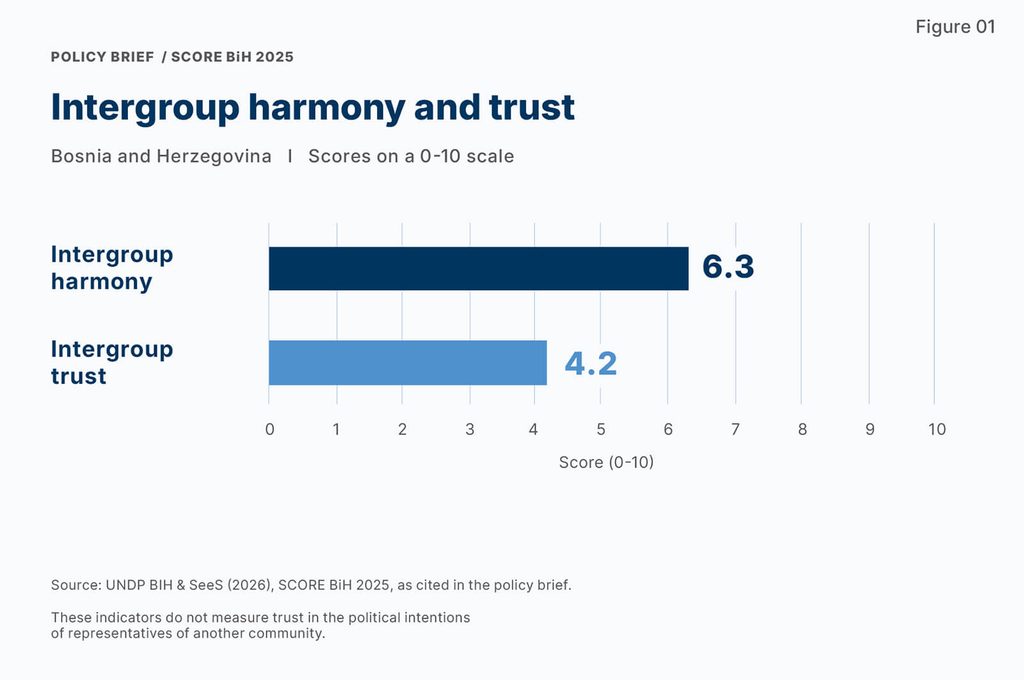
The SCORE 2025 research registers intergroup harmony at 6.3 and intergroup trust at 4.2 on a scale of 10 (UNDP BiH & SeeD, 2026). These data confirm limited intergroup trust with relatively functional everyday relations, but they do not measure trust in the political intentions of representatives of the other community nor prove the causes of political accommodation.
In this context, the relationship between the theory of intergroup contact and Lijphart’s analysis of segmental isolation is particularly significant. Pettigrew and Tropp (2006) show that intergroup contact generally contributes to the reduction of prejudices, while Lijphart (1977) considers segmental isolation as one of the possible favourable circumstances for reducing immediate tensions and for cooperation among political elites. Segmental autonomy, social isolation, and interpersonal contact are nevertheless not the same phenomena, nor do these theories necessarily explain the same dependent variable. The reduction of interpersonal prejudices is not the same as the stability of the political arrangement.
From this arises the question to what extent direct cooperation and mutual trust among individuals correspond to their readiness for political collaboration. Positive interpersonal
relationships can exist simultaneously with distrust towards the political intentions of another community, but the existence and magnitude of such a gap should not be assumed a priori.
At the same time, Lijphart’s favourable conditions, including overarching loyalties, crosscutting affiliations, shared perception of external threat, and tradition of compromise, should not remain mere assumptions derived from the institutional structure (Hadžić, 2026). Bogaards (1998) warns of the theoretical and empirical ambiguity of these conditions. Closest to the central message of this policy brief is the possibility that a jointly perceived risk of internal institutional decay serves as a catalyst for political accommodation.
Material interdependence, therefore, represents a possible resource for cooperation, but not its guarantee. The crucial question is under what conditions awareness of shared interests converts into support for common political action.
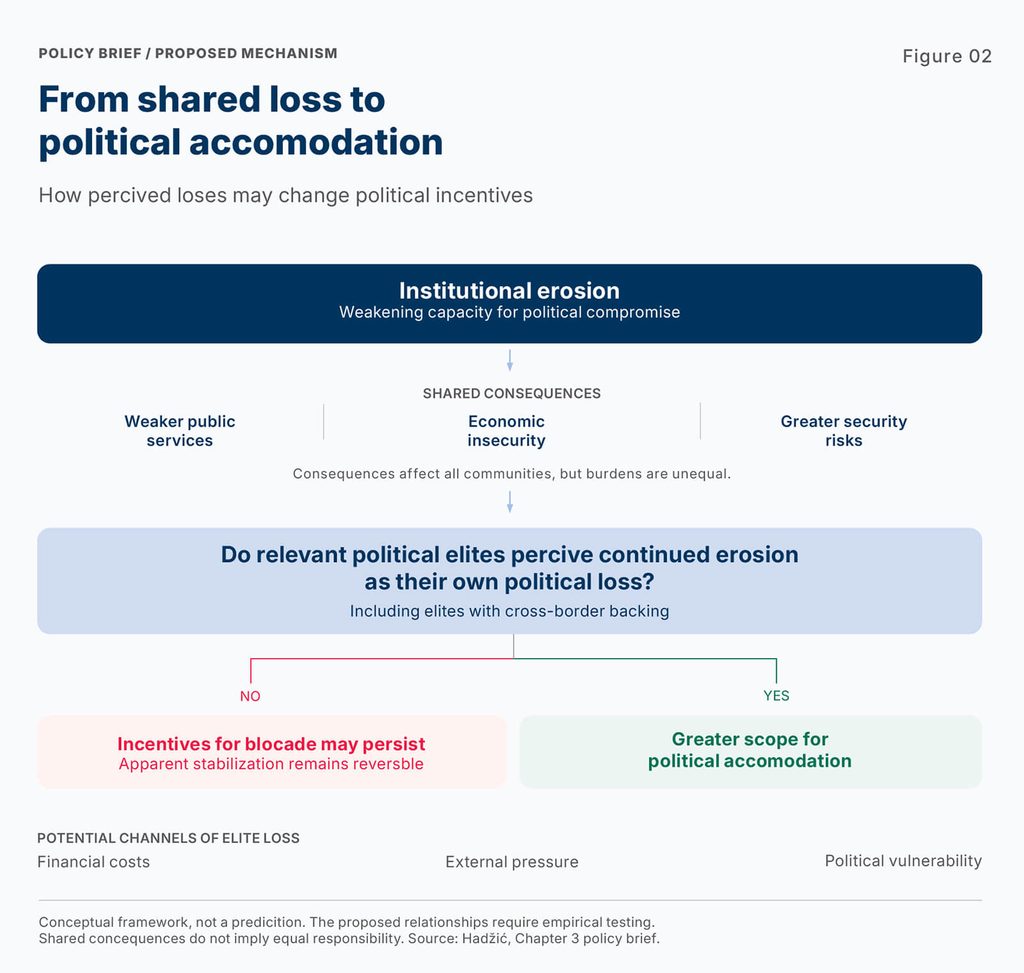
The author’s analysis of trends from 2006 to 2024 shows that the decay of the political system represents a common loss masked by apparent stabilization. The threat that a community attributes to the other side can strengthen internal cohesion around political elites. Conversely, systemic decay has consequences for all communities, but political elites do not, for now, perceive it as their own political loss; whether citizens perceive it is yet to be determined.
3.4. Possible forms of cooperation 2026–2030 and the conditions for its sustainability
The period 2026–2030 allows for the examination of possible changes in social and political relations during the next institutional cycle. In this regard, cooperation should not be understood as a single process of reconciliation, but its forms should be distinguished by the degree of political sensitivity and the mutual trust required.
Common infrastructure projects, protection from natural disasters, economic cooperation, and provision of public services can be achievable without agreement on fundamental political issues. By contrast, cooperation in education, institutional confrontation with the past, and formulation of long-term political goals require more complex forms of mutual recognition and institutional guarantees.
The sustainability of cooperation depends on legal protection, equality of participants, transparent distribution of benefits, and acceptability of expected losses. It is particularly important that cooperation is not conditioned on relativization of the past. Facts established by a final judgment cannot be subject to negotiated concessions, nor can future benefits be used as a substitute for recognition of historical responsibility. At the same time, acceptance of such facts does not require political uniformity or renunciation of legitimate differences in institutional preferences.
The possible development of relations can be considered through three conditional scenarios, based on the progression of practical cooperation and political trust. The first assumes functional rapprochement, in which the expansion of cooperation is accompanied by the growth of political trust. The second signifies selective cooperation with persistent political antagonism, where daily and economic relations are maintained without appropriate political accommodation. The third assumes a deepening of distrust, in which political and security expectations begin to limit even existing forms of cooperation.
These scenarios are not predictions, nor do they exhaust all possible outcomes. Their distinction requires linking existing social indicators with documented patterns of institutional behaviour and political elite actions. Particularly important is establishing under what conditions political
accommodation accompanies the growth of social trust, and when these two phenomena remain unconnected.
Which of these scenarios will prevail by 2030 will heavily depend on whether political elites, especially those with cross-border backing in Belgrade, perceive their own losses in the continuation of the erosion of the constitutional order of BiH. Losses inflicted on Serbia as a nation do not necessarily have the same effect as losses that directly threaten the position of the regime, as the national narrative may absorb the first. The regional experience shows that the Belgrade leadership, under the pressure of domestic political and international circumstances, has on two occasions limited support for the leadership of Bosnian Serbs: in August 1994 it cut ties with Pale and closed the border on the Drina, and in 1995 it took over the negotiations on behalf of Bosnian Serbs in Dayton. Both cases indicate the significance of the assessment of its own regime losses.
If the erosion were to progress to dismantling and attempts at unilateral changes to the constitutional order of BiH, the ruling elite in Belgrade could face three risks. The first is financial: Republika Srpska received around 1.55 billion KM from the indirect tax system in the first half of 2026 alone, and with the exit from the common constitutional order, this revenue would become uncertain, while the burden of its financing would shift to Serbia. The second is external pressure: the case of NIS showed how vulnerable Serbia is to sanctions, although the lifting of American sanctions against Dodik in October 2025 eased the pressure on Banja Luka. The third is Türkiye’s likely involvement in such a crisis. Given that Serbia is developing military, and Republika Srpska political and economic cooperation with Israel, the crisis could potentially transfer the Turkish-Israeli geopolitical confrontation to BiH, making Türkiye a volatile variable and a significant potential risk.
These risks are not limited to the aforementioned examples: attempts to unilaterally change the constitutional order of BiH would open the door to unpredictable consequences.
Recommendations
Recommendations are based on the findings that the decay of the system constitutes a hidden shared loss that can trigger political accommodation when relevant political elites recognize it as their own. Their implementation does not require constitutional changes or prior agreement by these elites.
- Draft and publicly present a geopolitical assessment of the risk that further erosion of the constitutional order of BiH would pose. Intended for: research and academic institutions, NGOs and international organizations. The assessment should identify possible losses for relevant political elites, particularly those with backing in Belgrade. For the political leadership of Serbia, it is necessary to consider financial implications, the risk of sanctions, the possibility of broader geopolitical engagement, and internal political vulnerability. The findings should be presented to the expert community and diplomatic missions in Sarajevo and Belgrade.
- Present the decay of the system as a shared loss, without obscuring political responsibility. Intended for: political parties, politicians, NGOs and media. Public discourse should be based on verifiable indicators of institutional deterioration, distinguishing the responsibility of concrete political actors from collective ethnic guilt. This makes the collective consequences of decay more visible, without strengthening the cohesion around political elites that might be produced by a threat attributed to another community.
- Investigate how citizens perceive the decay of the system and its consequences. Intended for: research institutions, think tanks and donors. Include a short questionnaire block in a public opinion survey that separately measures the perception of decay, attribution of responsibility, and perception of shared threat. The sample should allow for reliable comparison between Bosniaks and Serbs, and the findings should be interpreted in the context of SCORE 2025. Non-representative online surveys can only serve for preliminary exploration.
References
- Bar-Tal, D. (2007). Sociopsychological foundations of intractable conflicts. American Behavioral Scientist, 50(11), 1430–1453.
- Bogaards, M. (1998). The favourable factors for consociational democracy: A review.
European Journal of Political Research, 33(4), 475–496.
- General Framework Agreement for Peace in Bosnia and Herzegovina (1995). Preamble, including the agreement of 29 August 1995 authorizing the delegation of the Federal Republic of Yugoslavia.
- Hadžić, Z. (2026). Izostanak Lijphartovog efekta i jatrogenija vanjske intervencije u Bosni i Hercegovini [The absence of the Lijphart effect and the iatrogenesis of external intervention in Bosnia and Herzegovina]. Manuscript in preparation.
- Horowitz, D. L. (1985). Ethnic Groups in Conflict. Berkeley: University of California Press.
- International Court of Justice (2007). Application of the Convention on the Prevention and Punishment of the Crime of Genocide (Bosnia and Herzegovina v. Serbia and Montenegro). Judgment of 26 February 2007, I.C.J. Reports 2007, p. 43.
- Lijphart, A. (1977). Democracy in Plural Societies: A Comparative Exploration. New Haven: Yale University Press.
- Noor, M., Shnabel, N., Halabi, S., & Nadler, A. (2012). When suffering begets suffering: The psychology of competitive victimhood between adversarial groups in violent conflicts. Personality and Social Psychology Review, 16(4), 351–374.
- Pettigrew, T. F., & Tropp, L. R. (2006). A meta-analytic test of intergroup contact theory.
Journal of Personality and Social Psychology, 90(5), 751–783.
- Roeder, P. G., & Rothchild, D. (Eds.). (2005). Sustainable Peace: Power and Democracy after Civil Wars. Ithaca: Cornell University Press.
- UNDP BiH & SeeD (2026). Social Cohesion in Bosnia and Herzegovina: Key Trends Based on SCORE BiH 2025 with Comparative Insights from SCORE BiH 2020. Sarajevo: UNDP.
- United Nations (1994). Letter dated 19 September 1994 from the Secretary-General addressed to the President of the Security Council (S/1994/1074), transmitting the report of the Co-Chairmen of the Steering Committee of the International Conference on the Former Yugoslavia on the ICFY mission to the Federal Republic of Yugoslavia.
- Vollhardt, J. R. (2012). Collective victimization. In L. R. Tropp (Ed.), The Oxford Handbook of Intergroup Conflict (pp. 136–157). New York: Oxford University Press.
About the author
Zlatan Hadžić is a political scientist by training and a statistician by profession, with teaching experience as an expert practitioner at the Faculty of Political Sciences, University of Sarajevo. He holds a PhD in political science, a master’s degree in management and a bachelor’s degree in Arabic. His research examines the gap between normative models of politics and the way political actors, societies and institutions actually behave, with a focus on decision-making, political discourse and geopolitics. His broader academic interests include behavioural theory, epistemology and the philosophy of science.